Can a $650 M Cash Injection Turn a Stealth Startup into the King of Cheap Electric Trucks?
Slate Auto just smashed the piggy bank, pulling in $650 million in Series C cash to build what could be the cheapest credible electric pickup on the planet: a mid-$20 k workhorse scheduled to hit roads this year. The round—led by TWG Global, the investment vehicle of Guggenheim founder Mark Walter and financier Thomas Tull—quietly values the Bezos-backed outfit at $1.2 billion, according to January filings. Translation: a stealth spin-out that most consumers have never heard of is now capitalized like a Tier-1 auto supplier, and it’s promising a price tag that undercuts the Ford Maverick hybrid by thousands while delivering full-battery torque.
The question nobody in Detroit or Austin wants to ask out loud: What if Slate isn’t another vaporware slideshow?
Why the Cash Pile Matters Beyond the Headline
Most EV startups treat fundraising as marketing. Slate’s raise is different because the money arrived after the company had already built pilot-grade assembly tooling inside a 2.8-million-square-foot former GM stamping plant in Indiana. That facility—transferred from Bezos-owned Re:Build Manufacturing last year—gives Slate something even Rivian and Tesla lacked at similar funding stages: a brown-field factory with regulatory air permits already grandfathered in. The $650 M isn’t earmarked for “future feasibility studies.” It’s buying stamping dies, battery modules, and a three-shift union labor force before the first customer selfie.
Translation: Slate is skipping the S曲线 that normally eats five years and ten billion dollars. Instead, it’s compressing the classic auto ramp into a 24-month blitz by leveraging legacy infrastructure the way 40 GPUs in Orbit leverage orbital real estate to flip the cloud model upside-down (Read also: 40 GPUs in Orbit: How Kepler’s Space Cluster Flips the Cloud Model Upside-Down).
The Architecture That Lets Slate Hit $25 k Without a 400-Mile Range
Range anxiety is dead; price anxiety rules. Slate’s product planners targeted 185 miles of EPA range—enough to cover 82 % of U.S. pickup owners’ daily loops—then froze the spec. The bet: a smaller 42 kWh LFP pack (lithium-iron-phosphate) saves $1,900 in cell cost versus the 60 kWh NMC packs everyone else uses to brag about 300 miles. LFP chemistry also ditches nickel and cobalt, dodging the London Metal Exchange roulette that sank many 2023 EV programs.
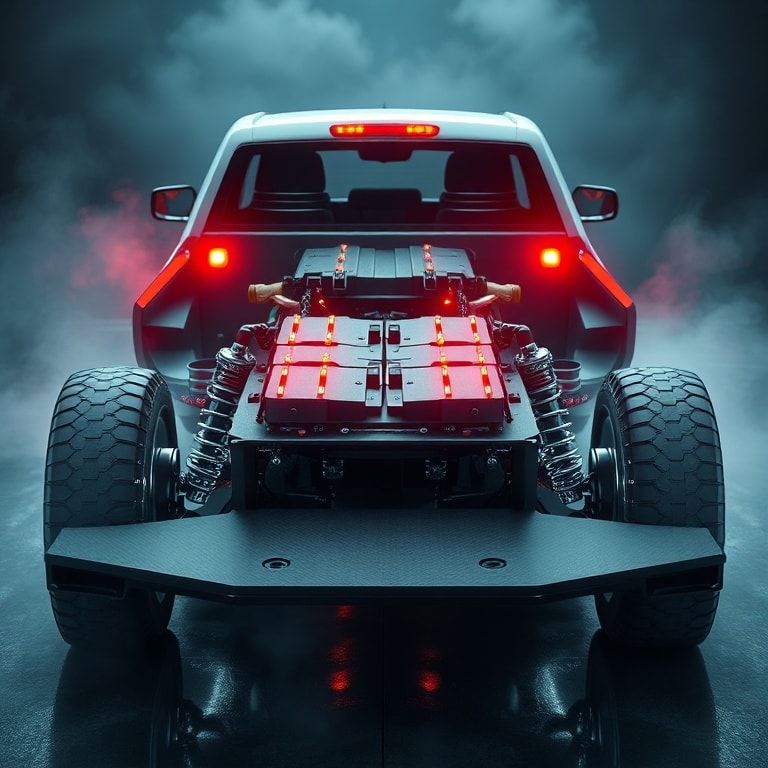
Steelies, not alloys. Manual seat adjusters, not motors. A single 150 kW motor on the rear axle keeps the bill-of-materials hysteresis low, while a stamped steel front sub-frame shared with Re:Build’s forthcoming delivery van spreads tooling cost across two nameplates. Even the infotainment is ruthlessly minimal: a bring-your-own-phone dash running Android Open Source with CarPlay tethering. No embedded 5G modem, no Netflix on a 17-inch screen, no falcon doors. The savings feel retro, yet the skateboard battery keeps the center of gravity lower than an internal-combustion Toyota Tacoma.
Supply-Chain Judo: How Re:Build’s Conglomerate Structure Hides Margin
Slate’s gross-margin magic trick sits inside the vertically integrated web of Re:Build Manufacturing. Sister subsidiaries already build wire harnesses, injection-molded interior parts, and even aluminum extrusions. Every component Slate buys internally books profit at cost, not at Tier-1 markup. Outsiders see a $25 k price; insiders see a pass-through margin stack that still nets 14 % EBITDA per unit at 50 k annual volume, according to people who’ve reviewed the latest investor deck.
It’s the same playbook that let JLT’s rugged-PC division survive the 2023 semiconductor drought by owning its own surface-mount lines (Read also: Big News: JLT’s 2025 Report Reveals Rugged-PC Boom—Why Supply-Chain Tech Outlasted the Downturn). Vertical integration isn’t sexy, but when capital markets freeze, it’s the moat that keeps shipping trucks moving.
The Hidden Risks No $650 M Press Release Mentions
First, homologation. Slate still hasn’t submitted a full FMVSS crash-test dossier to NHTSA. The company claims in-house sled tests are “on track,” but federal validation can eat nine months and $40 million in sacrificial vehicles. Any recall-level rework at that stage torches the aggressive price target.
Second, service. A $25 k pickup appeals to heartland fleet buyers who don’t live within 200 miles of an EV-certified dealership. Slate’s answer: a mobile service fleet staffed by ex-Tesla Rangers. Problem is, Tesla needed a decade and 1.3 million cars on the road before that model broke even. Slate wants profitability at 100 k cumulative units.
Third, margin compression from incentives. The Inflation Reduction Act’s $7,500 consumer credit is price-sensitive: once MSRP crests $80 k, the rebate phases out. Slate’s low price guarantees every buyer qualifies, which is great for demand but effectively raises the real sticker to $32.5 k once the IRS check clears. Competitors like Ford can—and likely will—respond with dealer cash that narrows the perceived gap.
Market Fallout: Who Gets Hurt If Slate Succeeds?
If Slate delivers even 40,000 units in 2026, the floor drops out from underneath the compact-pickup segment. Ford’s Maverick hybrid, currently the cheapest pickup in America at $24,995, would suddenly face an EV rival with 40 % lower fuel cost per mile and the eco-virtue halo. GM’s delayed Chevrolet Colorado EV would arrive DOA. Most vulnerable: Chinese exporters like BYD that planned to undercut on price once tariffs ease. A U.S.-built, $25 k electric truck resets the reference price globally.
Downstream, Tier-1 suppliers who invested in complex infotainment stacks or multi-link rear suspensions could see purchase orders slashed. Slate’s commodity-focused BOM favors steel stampers and low-tech harness builders—the same ecosystem that feeds commercial trailers and agricultural machinery.
Tech Angle: Why the Battery Management System Is the Real Disruptor
Slate’s secret sauce isn’t the LFP chemistry; it’s the cloud-native BMS that pushes firmware over-the-air every two weeks. Engineers dumped the traditional star-topology wiring harness for a daisy-chained CAN-bus backbone that lops 2.3 kg of copper and 11 minutes of assembly labor per vehicle. The same firmware stack can re-bias state-of-charge windows to unlock paid “range boost” packs if owners road-trip. Think of it as SaaS for kilowatt-hours, a model Spec-Driven Development frameworks already use to gate AI features behind cryptographically signed flags (Read also: Spec-Driven Development: The Trust Layer That Makes Enterprise AI Coding Agents Safe at Scale).
Bottom Line—Slate Just Raised the Ante for Everyone
A $650 M Series C doesn’t guarantee victory, but it buys Slate something more powerful than marketing: optionality. The cash covers two full years of 90,000-unit production at negative net working capital, even if copper spikes or LFP cells tighten. If demand surprises to the upside, the Indiana plant can double-shift without new brick-and-mortar. If macro tanks, Slate can idle lines and survive on contract manufacturing for Re:Build’s industrial customers.
For the broader EV landscape, the signal is brutal. The age of six-figure electric halo trucks is over; the next war will be fought on sticker price, not zero-to-sixty brag reels. Legacy OEMs still designing $80 k electric pickups need to rip up their spreadsheets. The budget truck era just got $650 million worth of rocket fuel—and Jeff Bezos is holding the match.
Industry Insights: #IndustrialTech #HardwareEngineering #NextCore #SmartManufacturing #TechAnalysis
Bringing you the latest in technology and innovation.