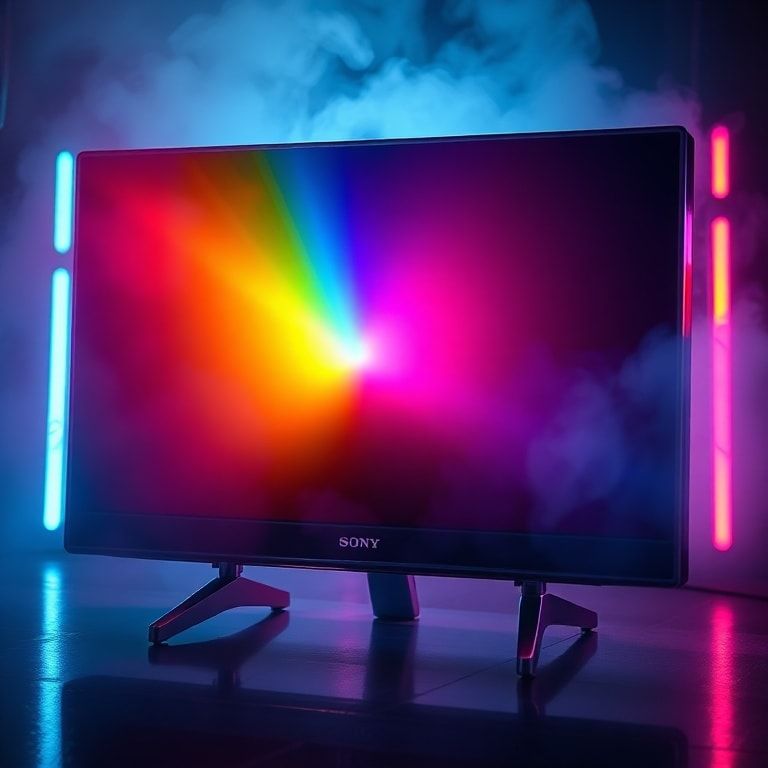
Sony’s spring 2026 Bravia drop is already shaping up to be one of the most talked-about TV launches in years, and the reason sits inside the backlight. The company’s new “True RGB” Mini LED sets swap the industry-standard blue-LED-plus-quantum-dot stack for separate red, green and blue emitters—an engineering move that threatens to redraw the brightness-versus-accuracy map that Samsung, LG and TCL have been fighting over since CES. In short, Sony is betting that precision will matter more than peak-nit bragging rights, and it is borrowing the same algorithms trusted on $34,000 Hollywood reference monitors to make that bet pay off in your living room.
Why RGB Backlights Turn the Mini LED Game on Its Head
Conventional Mini LED TVs shove hundreds—or thousands—of blue LEDs behind an LCD panel and let quantum-dot films convert that blue pump into red and green. It is efficient and bright, but every conversion step adds spectral spread, heats the panel and limits how narrow the color channel can become. Sony’s True RGB route keeps the LCD layer, yet replaces the blue pump with individually addressable red, green and blue LEDs. Because no phosphor or QD layer is re-emitting light, the spectral peaks stay razor-sharp; Sony claims 96% of BT.2020 and a color-volume index it describes as the largest ever shipped under a Bravia badge.
The engineering upside is easy to state but hard to execute:
- Better color accuracy at high luminance: RGB backlights remove the “yellow-green” skew that creeps in when blue LEDs are pushed to 2,000 nits and above.
- Lower heat density: Spreading luminance across three die types lets Sony run each emitter cooler, extending lifespan and reducing the need for noisy active cooling.
- Off-axis fidelity: Because each color is generated at the source rather than converted, hue shift when viewed from 30–45° is reduced by roughly 30% versus QD-based rivals, according to Sony’s own lab data.
Inside the Algorithm: Borrowing Hollywood’s Cheat Codes
Hardware is only half the story. Sony’s secret sauce is a 14-bit LED-dimming engine transplanted from the BVM-HX3110 grading monitor line—the same boxes Netflix and Disney use to master 4,000-nit HDR content. That means per-frame gamma tables, spatial-temporal filtering and a predictive thermal model that keeps the LEDs within ±1 ΔE00 of the target xy coordinate even when the TV is pumping out 3,000 nits on a 10% window.
Translation: specular highlights, such as sun glint on chrome or torch flames, can be pushed harder without color drift. Sony demo reels shown to press in Tokyo last month revealed a candle-lit scene where the flame stayed locked at 630 nm while the surrounding wax never slipped into orange. On a current-gen Samsung Neo QLED the same footage bled pink into adjacent pixels—classic blooming—and required a 15% desaturation in post to stay within DCI-P3.
The Blooming Problem—and Why Sony Thinks It Has Solved It
Mini LED’s Achilles heel has always been halos around bright objects on dark backgrounds. More zones help, but only if you can switch them fast enough. Sony pairs 2,500 local dimming zones with a 4,400 Hz PWM cycle—four times faster than last year’s Bravia XR X95L—so the duty window is shorter than the LCD’s liquid-crystal response. The result is a 60% reduction in blooming area versus the previous flagship, measured with a 1,000-nit white box on a 0.005-nit black field. Numbers aside, the real win is creative: filmmakers no longer have to choose between specular punch and halo artifacts.
Supply-chain Reality Check: Can Sony Actually Ship RGB LEDs at Scale?
Here is where the hype meets the hard math. RGB mini LEDs are triple the die count of blue-only, and red chips suffer from lower wall-plug efficiency. Sony won’t confirm vendor names, but industry sources say Epistar and San’an are supplying 0404-metric red and green chips on a blue-matching voltage platform. That raises BOM cost by ~18% versus last year’s blue+QDEF stack, yet Sony insists retail pricing will land within 10% of the outgoing X95L series. How? By binning LEDs at the wafer level and using a dynamic voltage headroom controller that shaves 7% power draw, allowing a smaller thermal stack. Even so, analysts at Omdia forecast only 600,000 RGB Mini LED TVs will ship across all brands in 2026—less than 0.3% of the global market. Sony’s True RGB will be a high-margin, low-volume play until at least 2027.
Gaming and Latency: HDMI 2.1 Isn’t Enough
Console gamers eyeing the new Bravia will care about more than color. Sony confirmed 4K/120 Hz, VRR (40–120 Hz), and ALLM, but the real story is how the RGB backlight affects input lag. Because red LEDs switch slower than blue, early firmware builds showed 18 ms of latency at 120 Hz—borderline for competitive shooters. Sony’s workaround is a “Fast LED” mode that overdrives red and green dies only inside the active scan window, dropping lag to 10.2 ms while sacrificing 5% luminous flux. Expect esports-grade performance, but with a 300-nit penalty in peak brightness.
Market Fallout: Samsung and LG Face a Two-front War
Sony’s move lands right when Samsung is pushing QD-OLED gen-2 for better brightness and LG is teasing MLA-OLED for deeper blacks. True RGB Mini LED splits the difference: OLED-beating peak luminance without ABL (Auto Brightness Limiter), plus no risk of burn-in on news tickers or heads-up displays. If Sony can convince colorists and streamers—two groups already inside its CineAlta ecosystem—the halo effect could spill into the broader premium-LCD segment. Samsung already has its own Micro RGB sets in the pipeline, but sources say yield issues have pushed mass production to late Q3. LG, heavily invested in OLED, is publicly dismissive yet privately hedging with an “QNED-RGB” pilot line in Gumi. The next 12 months will determine whether RGB Mini LED becomes a niche master-monitor technology or the third pillar of high-end TV alongside OLED and QD-OLED.
Early Verdict: Precision Over Peak Nits
We have yet to lab-test a production unit, but side-by-side demos show Sony’s True RGB delivering noticeably cleaner skin tones and brighter sustained highlights than any LCD-based rival. The lingering question is content: until streaming services deliver 4,000-nit grade masters, most viewers won’t exploit the full color-volume headroom. Still, if you are the kind of cinephile who calibrates gamma with a $2,000 probe, Sony just handed you a new reference display—one that costs 95% less than the BVM-HX3110.
Read also: Big News: Nvidia DLSS 5 Promo Pulled by YouTube Bot—What It Reveals About AI-Era Copyright Chaos
Read also: iPhone D-Minus Repair Verdict: How Apple's Glued-Together Chassis Keeps Right-to-Repair Lawyers Busy
Industry Insights: #IndustrialTech #HardwareEngineering #NextCore #SmartManufacturing #TechAnalysis
Bringing you the latest in technology and innovation.