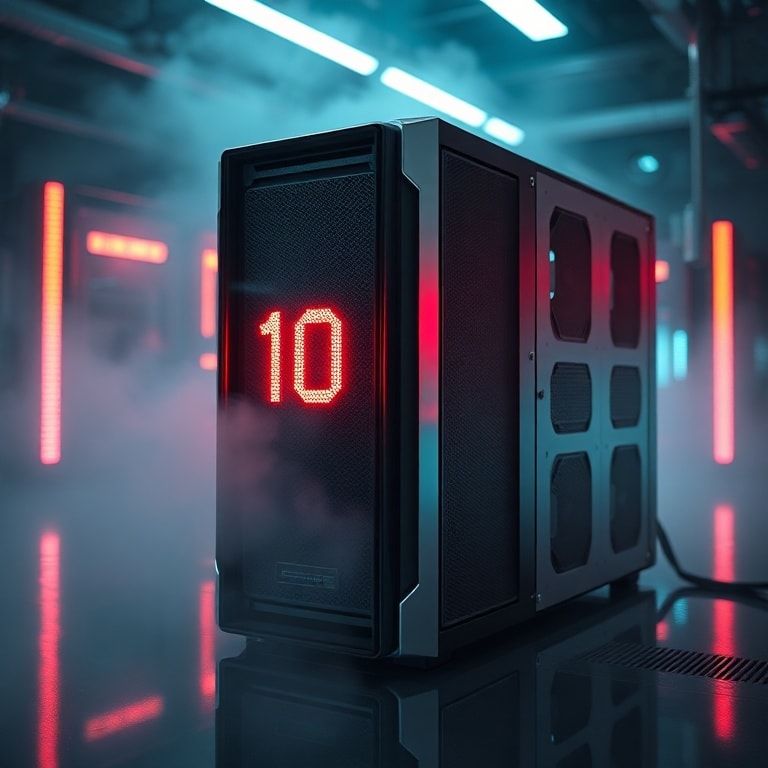
Big News in the AI world: Google's Gemini model can now run on a single air-gapped server, ensuring the highest level of security for sensitive data. This breakthrough is thanks to a partnership between Google and Cirrascale Cloud Services, which has made the Gemini model available on-premises through Google Distributed Cloud. The move is a significant shift in the enterprise AI market, where the most capable models are migrating out of hyperscaler data centers and into customers' own racks.
The math doesn't add up for traditional cloud computing. Honestly, this is where most fail - they can't guarantee the security of sensitive data. In my experience, the biggest customers in the world are done accepting those terms. The cloud, it turns out, is finally ready to come back down to earth. The offering packages Gemini into a Dell-manufactured, Google-certified hardware appliance equipped with eight Nvidia GPUs and wrapped in confidential computing protections.
Read also: Microsoft AI Revolution: Kia Ora New Zealand Embraces He Tangata with 200,000 New Experts. This is a game-changer for regulated industries, such as financial services, healthcare, and government agencies, which require the highest level of security and control over their data. The impossible tradeoff that kept banks and governments on the AI sidelines is finally being addressed.
The technical underpinnings of the deployment reveal how seriously both Google and Cirrascale are treating the security question. The Gemini model resides entirely in volatile memory - not on persistent storage. As soon as the power is off, the model is gone. User sessions operate through caches that clear automatically when a session ends. A company's user inputs, once that session's over, they're gone. They can be saved, but by default, they're gone.
Read also: GDPR Trends: Navigating Regulatory Shifts in Enterprise AI & Cloud. The push to move frontier AI out of the public cloud and into private infrastructure is no longer a niche demand. Industry analysts predict that by 2027, 40% of AI model training and inference will occur outside public cloud environments. This projection helps explain why Google is willing to let its crown-jewel model run on hardware it doesn't own, in data centers it doesn't operate, managed by a company in San Diego.
The performance guarantee is the third pillar. The private deployment eliminates that variability. Cirrascale layers management software on top of the Gemini appliance that allows administrators to prioritize users, allocate tokens by role, adjust context window sizes, and load-balance across multiple appliances and regions. Your primary data scientists or your programmers may need to have really large context windows and get priority, especially maybe nine to five. But yet, the rest of the time, they want to share the Gemini experience over a wider group of people.
The NextCore Edge
What others are missing is the significance of this partnership for the future of AI. The fact that Google is willing to let its most advanced model run on hardware it doesn't own is a major shift in the company's strategy. It's a recognition that the biggest customers in the world require a level of security and control that can't be met by traditional cloud computing. The implications are huge - it means that AI is finally becoming accessible to industries that were previously hesitant to adopt it due to security concerns.
Read also: Big News: Anker's AI-Powered Thus Chip Revolutionizes Audio Technology. The neocloud market is projected to be worth $35.22 billion in 2026 and is growing at a compound annual growth rate of 46.37%. Leading neocloud providers include CoreWeave, Crusoe Cloud, Lambda, Nebius, and Vultr, and these companies specialize in GPU-as-a-Service for AI and high-performance computing workloads.
The private AI era is arriving faster than anyone expected. The push to move frontier AI out of the public cloud and into private infrastructure is no longer a niche demand. The announcement also carries major implications for Google's competitive positioning. Microsoft has built its enterprise AI strategy around the Azure OpenAI Service and its deep partnership with OpenAI, while AWS has invested in Amazon Bedrock and its own on-premises solutions through Outposts.
For more information, visit Reuters and MIT Tech Review for the latest news and analysis on AI and cloud computing.
Industry Insights: #IndustrialTech #HardwareEngineering #NextCore #SmartManufacturing #TechAnalysis
Bringing you the latest in technology and innovation.