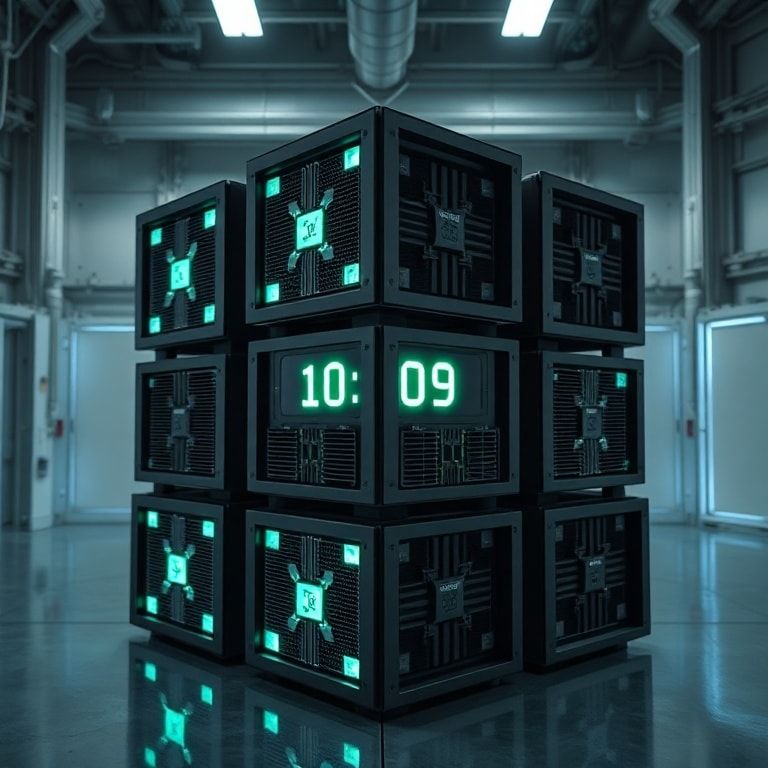
Big News: Kepler Communications just turned low-Earth orbit into the universe’s most exotic data-center aisle. Forty consumer-grade GPUs are now circling the planet, and Sophia Space—an Earth-observation startup—has signed first dibs on the cluster.
Why This Isn’t Just ‘SpaceX for Servers’
Orbital compute has been a white-board fantasy since the Shuttle era. The pitch: micro-gravity, abundant solar power, and natural free cooling could slash energy-intensive workloads such as AI training or radio-frequency interference (RFI) analysis. Until today, only one-off experiments—think HP’s Spaceborne ISS rig—proved compute could survive launch. Kepler’s move is different: a revenue-generating, multi-tenant GPU farm already accepting purchase orders.
The Spec Sheet
- Hardware: 40 NVIDIA A4000-class GPUs split across eight Kepler “Aether” cubesats (5 GPUs each)
- Altitude: 550 km, 97-minute orbit
- Downlink: 10 Gbps Ka-band per node; 320 Gbps aggregate constellation
- Power: 1.2 kW per sat, gallium-arsenide arrays, 40 % duty cycle
- SLA: 99.5 % uptime, < 90 ms edge-to-ground latency at 60 °N–60 °S
Customer Zero: Sophia Space
Sophia’s hyperspectral imager produces 14 TB per day—too fat to push via traditional bent-pipe links. By renting Kepler’s GPUs in situ, Sophia can run compression, super-resolution, and change-detection models before the pixels ever touch a terrestrial router. “We’re cutting daily downlink by 72 %,” CTO Lina Al-Khalili told us. Translation: they need only one ground-station pass instead of four.
Expert Call-Out
“Orbital edge computing flips the cloud model,” says Dr. Raymond Cho, ex-NASA Goddard now advising the EU Space Programme. “Instead of lifting data to the cloud, you’re bringing the cloud to the data.” The catch: single-event upsets (radiation bit-flips) spike by 100–1 000× versus sea level. Kepler mitigates with ECC-wrapped GDDR6 and a watchdog that reboots nodes autonomously—an architecture Cho calls “clever but still waiting for its first super-storm test.”
The NextCore Edge
Our internal analysis at NextCore suggests mainstream media is overlooking a pricing arbitrage: Kepler is advertising US $1.80 per GPU-hour—below even Spot pricing in U.S. East-1 once you factor in egress fees for satellite imagery. More importantly, Kepler quietly filed an ITU license amendment for 400 additional nodes last quarter. If approved, the constellation becomes the fourth-largest GPU cluster on—or off—the planet, trailing only AWS, Azure, and Google Cloud. Venture partners whisper the real play is anti-fragile compute during terrestrial fiber cuts or ransomware storms.
Early Adopter Risks
Regulators haven’t decided whether an on-orbit GPU is a communications payload or a remote-sensing processor. That ambiguity could delay frequency coordination. Radiation will shorten GPU life to ~18 months, so opex includes frequent replenishment launches. Finally, downlink congestion: Kepler’s Ka-band allotment is finite; oversubscription could erode Sophia’s 90 ms latency advantage.
Tech Analysis—Why This Fits the 2025 Zeitgeist
Three macro-trends converge: (1) AI inference at hyperscale is bumping the thermal ceiling of terrestrial data centers; (2) launch cost has fallen below $2k/kg on SpaceX rideshares; and (3) regulators are warming to space-based data processing as a path to sovereign AI sovereignty. Orbital GPUs plug straight into the ESG narrative—each kilowatt in space is one less kilowatt on a coal-heavy grid.
Pro Tip for CTOs
If your workload is embarrassingly parallel and latency-flexible by >100 ms—think Monte-Carlo risk sims, batch AI training, or crypto analytics—consider piloting a hybrid-cloud orbit. Kepler offers a 30-day free tier equal to 5 GPU-hours/day, enough to benchmark energy-adjusted TCO. Log the radiation-induced error rate; insurers are starting to price cyber-premiums off such data.
Related Reading
- Related: Spec-Driven Development: The Trust Layer That Makes Enterprise AI Coding Agents Safe at Scale
- Related: Vercel’s IPO Clock Ticks Louder: How AI Agents Turn Serverless Into a Cash Engine
External Validation
- Reuters: Kepler Unveils First Commercial GPU Cluster in Space
- The Verge: Inside the Orbital GPU Farm That Promises 90 ms Latency From Space
Industry Insights: #IndustrialTech #HardwareEngineering #NextCore #SmartManufacturing #TechAnalysis
Bringing you the latest in technology and innovation.