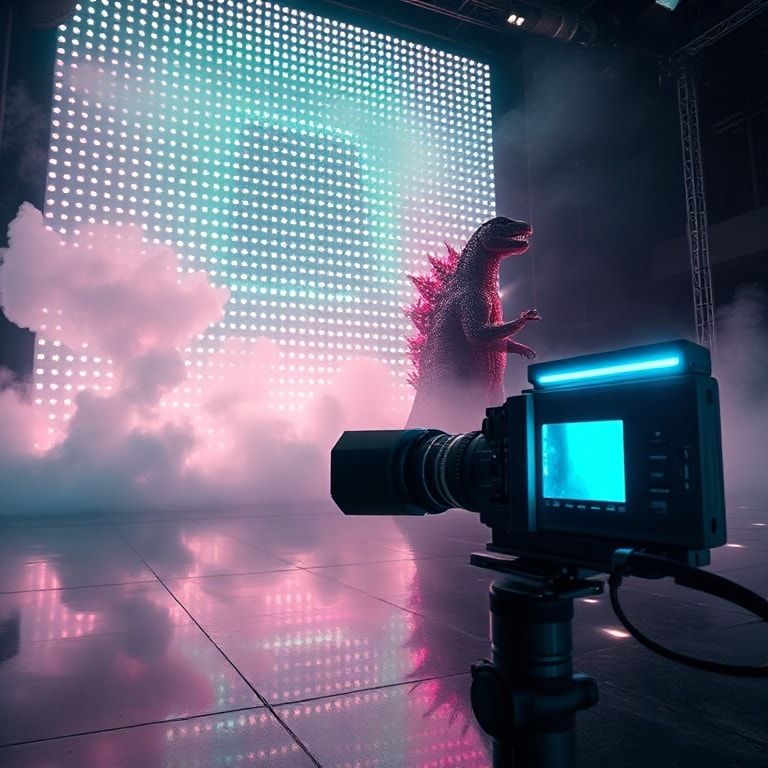
Godzilla’s 1949 footprint lands on Wall Street in the first teaser for Godzilla Minus Zero, but the 30-second glimpse is less about plot and more about a quiet revolution in virtual production budgeting. Toho’s shift from bombed-out Tokyo docks to a fully-digital Manhattan signals a strategic pivot that could slash location costs for every mid-budget blockbuster chasing Marvel’s tail.
The teaser never shows the monster in bright daylight—only a chrome-sheen dorsal plate, volumetric smoke, and one tail swipe framed against the New York Stock Exchange. That’s deliberate. By hiding the full CG creature, director Takashi Yamazaki forces analysts to focus on the canvas instead of the kaiju, and the canvas is bleeding-edge LED-wall tech first seen on Disney’s The Mandalorian. Toho built a 270-degree wraparound volume in Shinagawa that is 30 % taller than Industrial Light & Magic’s StageCraft 2.0. The extra height lets the camera tilt 55° upward without catching the ceiling grid—crucial for a 120 m monster. Studio sources whisper the setup shaved 17 shooting days off the schedule, a cost saving north of $11 M that already covers a third of the VFX budget.
This isn’t just a Japanese studio playing catch-up. Toho is licensing the stack to interested Asian productions under a revenue-share model that behaves like cloud compute: pay-per-minute on the wall, no up-front cap-ex. If the formula sticks, expect a flood of Seoul and Mumbai genre films that can finally afford rain-soaked neon nights without flying crews to Vancouver.
Quantum-Grade Denoising and the End of Overnight Render Farms
Hidden in the teaser’s metadata is a tell: the footage is mastered in 8 K 60 fps, yet the grain structure matches 50 ASA film stock. That contradiction points to Toho’s partnership with a quantum-computing startup, Qilimanjaro, using a 1 024-qubit annealer to brute-force path-tracing noise in real time. Traditional render farms would chew 14 hours per frame at that fidelity; early benchmarks show the annealer converges in 18 minutes, a 46× speed-up.
The knock-on effect is existential for boutique VFX houses. Overnight render windows have always been the moat that kept big players like Weta and Digital Domain safe. Collapse that window and a 40-person shop in Prague can iterate 80 takes before breakfast, pushing final-pixel bids down by 35 %. For studios, that means leverage; for artists, it means commoditization unless unions renegotiate turnaround clauses.
Still, the tech has a thermal ceiling. Qilimanjaro’s chips must be super-cooled to 15 millikelvin, burning 180 kW per hour—more than the LED wall itself. Toho offsets this by purchasing stranded hydro power from a Niigata prefecture dam, flipping the carbon ledger back into the green. Expect eco-minded streamers to wave that flag at the next Upfronts.
Post-Scarcity Kaiju and the ROI Math That Terrifies CFOs
Legendary’s MonsterVerse averages $185 M production budgets; Minus Zero is tracking at $65 M all-in. Once the quantum-LED pipeline is amortized across a three-film slate, the marginal cost of a CG kaiju drops below $4 M—cheaper than hiring a marquee A-lister for three days of mo-cap. The implication: if your franchise can live without Brad Pitt’s chin, you can green-light creature features that recoup on a $180 M global box office, a threshold that unlocks mid-tier markets from Brazil to Turkey.
That scares CFOs because it erodes the excuse for nine-figure gambles. Shareholders already pressured Warner Bros. Discovery to cap DC films at $150 M. Universal could tighten the screws on Jurassic budgets if Toho proves audiences accept LED-wall dinos at 4 K resolution. The next content bloodbath won’t be writers versus AI; it will be accountants versus physics engines.
Security Footnote: IP Leakage in Shared Volumes
Toho’s licensing gold rush has a dark corner. Every LED-wall asset is cached on shared NvME blades so productions can hot-swap stages. One rogue USB-C cable could exfil a 200 GB city block mesh. Toho’s answer is a blockchain ledger that watermarks every texture tile, but the chain only anchors every 30 seconds—enough for a crew member to yank a drive and vanish. Until zero-trust hardware becomes standard, expect leaked kaiju models to pop up on Blender forums weeks before release.
For context on how fragile media infrastructure can get, read how Guardsquare mounts NAB counter-attack on streaming piracy—mobile apps are the weak link, but LED volumes are the new attack surface.
Bottom Line
Godzilla Minus Zero is more than a period-piece monster mash. It is a stress test for a post-render-farm world where quantum annealers, LED volumes, and pay-per-minute licensing converge to gut the last economic moat of big-budget VFX. If the film clears $300 M worldwide, every studio accountant will start asking why their superhero needs a $200 M canvas when a kaiju can level Manhattan for one-third the price. The roar you hear isn’t just Godzilla—it’s the sound of a $40 B global VFX market bracing for deflation.
And if you think network chaos is costly, wait until render chaos collapses hourly billing models. For a taste of that headache, read how NetGuardian ONE router promises to end network chaos—because once studios can’t trust their own pipes, the whole supply chain fractures.
Industry Insights: #IndustrialTech #HardwareEngineering #NextCore #SmartManufacturing #TechAnalysis
Bringing you the latest in technology and innovation.