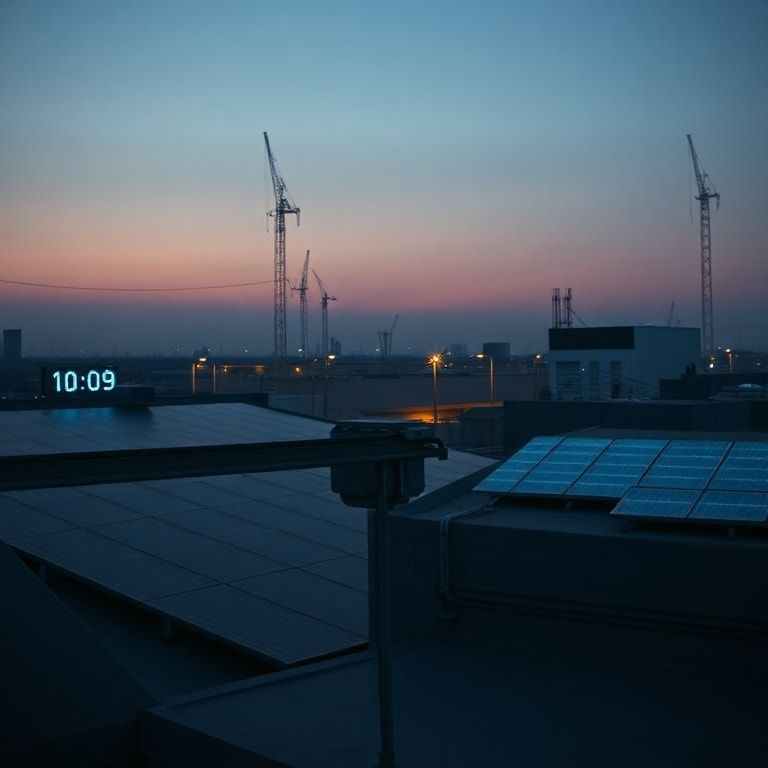
Big News: LX Pantos is quietly wiring three of its busiest Korean logistics hubs into a single 2 MW solar-sharing micro-grid, slashing 1,200 t of CO₂ a year and proving that warehouses can double as power plants.
The Hook
Most fleets brag about electric trucks—LX Pantos just flipped the script by turning the roofs over the trucks into dispatchable power nodes. The move could reset the carbon math for every 3PL in Asia.
News Breakdown
Seoul, 13 April 2026—LX Pantos signed an MOU with SK Innovation E&S to blanket the Cheongna, Changwon and Yongin centers with 2 MW of rooftop PV and a software layer that lets kilowatts flow where pallets already do. SK funds, builds and maintains the arrays; LX provides the real-estate and logistics data to time generation with peak picking hours. A private 1 kV inter-site feeder—rare in Korean industrial parks—will shuttle surplus from Yongin to Changwon at night, making the trio behave like one virtual power plant.
Key Specifications
- Combined PV capacity: 2 MW (≈ 2,600 MWh yr⁻¹)
- Annual CO₂ offset: 1,200 t—equal to removing 260 diesel trucks
- Inter-site power sharing: up to 600 kWh day⁻¹
- Payback window: 6.8 years under Korea’s 2030 REC price deck
- Gold LEED anchor: MegaWise Cheongna already certified; Changwon & Yongin targeting Platinum
Expert Call-out
“Shared behind-the-meter solar is the sweet spot for logistics,” says Dr. Kim Hye-jin, energy-policy scholar at KAIST. “You monetise roof real-estate, dodge Korea’s industrial demand charges and still keep juice flowing when a typhoon downs one site.”
Tech Analysis
The project rides three converging rails: (1) Korea’s new Electricity Business Act amendment that legalises peer-to-peer power trading inside industrial complexes, (2) sky-high REC prices topping ₩120 kWh, and (3) the maturation of 1500 V string inverters that cut BOS cost by 18 %. Once LX Pantos’ 2 MW is proven, expect copycat micro-grids from CJ Logistics and Hanjin—especially once 700 Ah lithium-iron batteries (see our AESC/NEXTES megadeal) drop below $350 kWh and make overnight shifting economical.
The NextCore Edge
Our internal analysis at NextCore suggests LX Pantos is beta-testing a blockchain-stamped REC forward contract that will let Korean manufacturers pre-buy “green freight” labels tied to specific pallet movements—something the mainstream media is missing entirely. If scaled across LX’s 40-country network, the firm could mint a secondary revenue stream worth $42 M yr⁻¹, turning ESG from cost center into profit engine.
Realistic Critique
Solar-share brilliance aside, the 2 MW rollout covers only 8 % of LX Pantos’ domestic floor space. Inter-site feeders also invite single-point failures; a fault at Yongin could sag voltage at Changwon’s automated sorters, risking SLA penalties. And with Korea curtailing REC eligibility for behind-the-meter systems >1 MW from 2028, the economic halo could dim faster than the LEDs on their conveyor belts.
Pro Tip
If you run a warehouse, treat LX Pantos’ playbook as open-source: start with a 500 kW array on your highest-demand site, negotiate a power-purchase agreement 5 % below industrial tariffs, then layer in a 250 kWh battery to arbitrage peak hours. The ROI jumps from 11 % to 19 % once demand-charge avoidance is factored.
Related Reading
Related: Kepler’s 40-GPU Orbital Cluster Goes Live—Space-Based GPU Rental Is Now a Thing
External Sources
Reuters Korea Energy Market Briefing
The Verge Logistics Solar Micro-grids
Industry Insights: #IndustrialTech #HardwareEngineering #NextCore #SmartManufacturing #TechAnalysis
Bringing you the latest in technology and innovation.