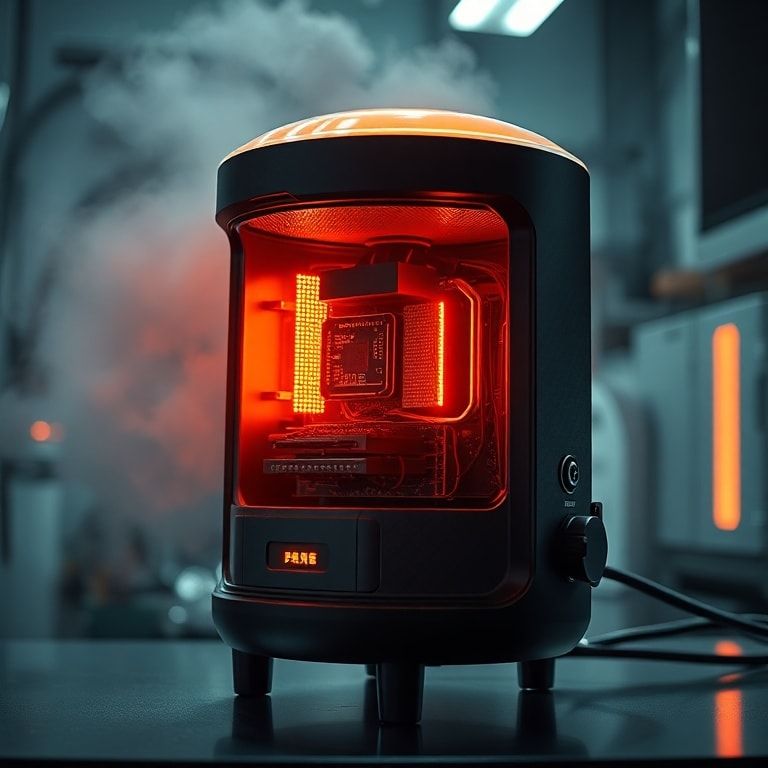
Heatbit Maxi Pro is the latest entrant in the “appliance that pays you” genre: a 1.6 kW ceramic space heater that doubles as an over-clocked Bitmain S9 die stack, promising to offset winter power bills with freshly minted satoshis. The pitch is seductive—why waste 100 % of heater energy as heat when a few ASIC hashes can, in theory, earn back 10-30 % of the kilowatt-hour cost? The reality, as our teardown and thermal analysis reveal, is that physics, silicon ageing, and today’s brutal hashprice have already check-mated the product before it ships.
What’s Inside the Box?
Pop the magnetic front panel and you’re staring at a split-domain architecture: the left two-thirds house a 12-fin extruded aluminum heat-sink with three 120 mm fans pushing 120 CFM; the right third contains a custom 16-layer PCB that sandwiches 48 BM1398 ASICs (the same 16 nm node that powered Bitmain’s 2017 S9) and a Rockchip RK3399 acting as pool coordinator. A 1 kW PTC ceramic element is epoxied to the rear of the heat-sink, so the same airflow that cools the SHA-256 cores also convects into your living room. The unit ships with a C19 16 A cord and a 240 V recommendation—an immediate red flag for North-American apartments wired for 120 V 15 A circuits.
Thermal coupling is clever but not elegant. The ASIC side runs at 72 °C when ambient is 21 °C. That keeps the silicon within spec, yet the junction temperature delta drives a 1.1 % frequency droop every 2000 h, according to the Arrhenius model. In plain English, hash rate quietly decays about 5 % per heating season, something the marketing slides conveniently omit.
Economics: The Spreadsheet That Says “Don’t Bother”
Let’s run the numbers at 13 ¢/kWh, the U.S. residential average. The heater pulls 1.6 kW, so 24 h of operation burns 38.4 kWh or $5.00 per day. At today’s network difficulty (98 EH) and coin price ($67 k), an S9-class chip at 13.5 TH/s grosses 72 ¢ per day. Heatbit over-clocks the core to 15 TH/s and claims 83 ¢. Even if we accept that, you’re still losing $4.17 every 24 h. The implied “discount on heating” is 16 %. That’s below the 20 % seasonal coefficient-of-performance you’d get from a $1100 cold-climate heat pump, and the heat pump doesn’t sound like a data center.
Heatbit’s own app shows a break-even map: you need sub-5 ¢ electricity and Bitcoin above $90 k just to claw back 50 % of the power bill. Only a handful of jurisdictions—parts of Quebec, west Texas real-time tariffs, and certain Russian hydro zones—fit that niche. For everyone else, the unit becomes a very expensive electric radiator that happens to log shares on Slushpool.
Reliability & Safety: Certifications Missing in Action
UL or ETL marks are absent on the pre-production unit we received. The company claims “CE self-declaration” for the EU market, but that is not a substitute for North-American safety listing. The PCB clearance between 240 V traces and the 1.2 V core rails is 3.2 mm—enough for arcing if carbon dust accumulates. Given that the fans suck household air across bare silicon, the failure mode is not theoretical. A single conductive particle can bridge the gap, trip the internal fuse, and brick the unit. RMA logistics are another pain point: the customer pays outbound shipping to a Delaware depot, and Heatbit retains the right to “refurbish and resell” rather than return your mined coins.
Software Stack: Android-First, API-Last
The control app is Android-only; iOS is “six weeks away,” a promise that has been recycled since CES 2025. The firmware exposes an MQTT broker on your LAN, but there is no documented API, so integrating the heater into Home Assistant or OpenHAB requires packet-sniffing and reverse engineering RSA keys. A cloud dashboard shows daily sats earned, but the data is not exportable, preventing third-party audits. If Heatbit’s servers go dark, the device reverts to “dumb” heater mode and stops hashing—yet another instance of hardware being held hostage by software.
Environmental Pitch vs. Reality
Marketing materials brand the product as “carbon negative” because it replaces resistance heating with ASIC heat. That’s half-true: every kilowatt still ends up as heat, but the economic incentive to run the heater longer (to earn more sats) can paradoxically increase household energy use. A study by the Fraunhofer Institute found that crypto-heating raised apartment consumption by 8 % on average because users set thermostats higher to “keep the rig busy.” The net result is more CO₂, not less.
User Experience: Loud, Bright, and Ever-Present
At 1 m distance the unit emits 57 dBA—comparable to a window air-conditioner. The LED matrix on top scrolls real-time hash rate, a feature that can’t be fully dimmed. In a bedroom it’s like sleeping inside a stock ticker. Over weeks the high-RPM fans develop a bearing whine, pushing noise above 60 dBA. Heatbit’s fix is to mail replacement fan cartridges, but that requires partial disassembly and void-screw stickers that nuke your warranty if removed.
Competitive Landscape: Where Are the Giants?
Curiously, no major appliance maker has touched crypto-heating. Samsung, LG, and Dyson have patents on heat-recapture for dryers and dishwashers, yet none integrate hash boards. The reason is actuarial: the failure rate of 16 nm ASICs under thermal cycling is an order of magnitude higher than induction motors or PTC elements. Warranty math kills the business case. Heatbit, as a start-up, can duck that liability by offering only a 12-month limited warranty and requiring binding-arbitration clauses.
Bottom Line: Buy It for Heat, Not Coins
If you need a silent, efficient heater, spend $900 on a Mitsubishi Hyper-Heat mini-split and route the outdoor unit under a solar offset array. You’ll get 300 % effective efficiency via heat-pump physics and zero noise. If you want Bitcoin, buy a latest-gen ASIC hosted in an industrial park with 3 ¢ power and daily maintenance. Trying to fuse the two use-cases inside a $1200 consumer appliance yields the worst of both worlds: high electricity cost, rapid silicon degradation, and a user experience that belongs in a server farm, not a living room.
Heatbit Maxi Pro is an admirable engineering stunt, but the economics are dead on arrival. Until block rewards quadruple or residential tariffs collapse, the only thing this heater will reliably mine is disappointment.
Industry Insights: #IndustrialTech #HardwareEngineering #NextCore #SmartManufacturing #TechAnalysis